
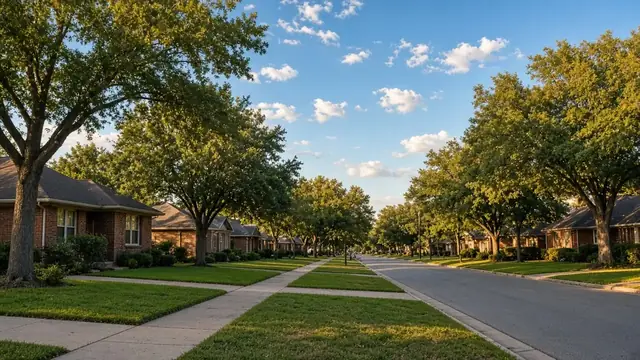
We Buy Houses in Fort Worth, As-Is
Sell to Cash Home Advisors without repairs, close in 7–14 days, and let us pay all closing costs.
- Close in 7–14 days
- We pay all closing costs
- Sell as-is, no repairs
Get Your Free Cash Offer
Cash Home Advisors buys houses in Dallas–Fort Worth, Houston, San Antonio and Austin. You can sell as-is, without making repairs. We can close in 7–14 days, and we pay all closing costs. Se habla español.
Who buys your house: Cash Home Advisors, LLC signs the purchase contract with you. We may buy your home ourselves or with a partner investor, and we tell you which before you sign. Every sale closes at a Texas title company on a standard TREC contract. Adrian Luna is a licensed real estate agent in the State of Texas (TREC #675272-SA). Cash Home Advisors, LLC buys property as a principal and is not acting as your agent, lender, or advisor.
The rest of this page is the local groundwork for a Fort Worth sale: which county your address sits in, which offices set and collect your taxes, where deeds are recorded, and what the city and the courts do when a house is vacant, behind on payments, inherited or rented to someone who will not leave.
One city, five counties
Fort Worth is bigger than most people picture. The city's own comprehensive plan chapter on intergovernmental cooperation says its taxable city limits take in portions of five counties: Tarrant, Denton, Parker, Johnson and Wise. Census figures put nearly every resident in Tarrant County, Denton County or Parker County; the Johnson and Wise pieces each hold fewer than 100 people. The Census Bureau estimated the city at 1,008,106 residents in 2024 (city and town population totals).
Why this matters to a seller: each county runs its own appraisal district, tax office, county clerk, probate court and justice courts. A Fort Worth mailing address does not tell you which one handles your house. Your property tax statement does, and so does a search on the appraisal district site. Denton County explains on its appraisal districts page that since January 1, 2008, an appraisal district's boundaries match its county's boundaries, so the county your house is in decides the district.
If your address is in Tarrant County
- Tarrant Appraisal District (TAD) sets the appraised value and takes homestead exemption applications; its appraisal review board hears value protests. TAD notes there is no fee to file an exemption.
- The Tarrant County Tax Assessor-Collector says the county has the most property tax accounts of any county in Texas. If taxes are past due, the office explains that each taxing entity (city, county, school district) hires its own delinquent-tax attorney.
- Deeds are recorded by the Tarrant County Clerk, which lists a recording fee of $20 for the first page and $4 for each page after that.
If your address is in Denton County
- Values and exemptions: Denton Central Appraisal District.
- Tax bills and payments: the Denton County Tax Assessor/Collector.
- Deeds: the Denton County Clerk's Recording Division, which keeps the county's real property records.
If your address is in Parker County
- The Parker County Appraisal District appraises the property, and it is also where Parker County property taxes are paid. The county's Tax Assessor-Collector page says that office strictly handles vehicle registration and does not appraise property.
- Deeds go to the Parker County Clerk. Its page cites Local Government Code 191.010: anyone presenting a document in person for the real property records must show photo ID.
City of Fort Worth rules that touch a sale
Code compliance and substandard houses
Fort Worth Code Compliance handles high grass, debris, open vacant buildings and substandard structures. The city describes a substandard structure as a building that falls short of its building, plumbing, electrical and mechanical codes and endangers the public. An officer documents the violations and sends the list to the owner. If the work is not done in time, the owner may have to appear before the Building Standards Commission, which can decide whether the structure should be demolished.
Vacant houses carry their own risk. The city's open and vacant structures page says owners who fail to secure a vacant building may be fined up to $2,000 per violation. The department's main page says grass and weeds must be kept under 12 inches. If your house has an open case, ask the department for a payoff figure (its pages list a contact for disputes and payoff requests) so the amount is known well before closing day.
Stopping water service
Fort Worth Water handles opening, closing and transferring accounts at 817-392-4477. To stop service, have the address or account number, the stop date and a forwarding address for the final bill. Any deposit on file is applied to the final bill and the rest is sent to you. A stop date on or after closing day keeps the water on for the final walk-through.
Repair help if you would rather stay
Selling is not the only answer to a broken water heater or a failing roof. The city's Priority Repair Program covers emergency and mechanical repairs for owner-occupied homes inside city limits: sewer, water and gas line breaks, water heaters and heating in the first tier, then electrical failures, roof repairs, unsafe air conditioning and rotten or sagging subfloors. Household income cannot exceed 60% of area median income ($66,180 for a family of four, per the city), and the home's value must be at or below 80% of the city's median. The program's number is 817-392-7548.
Behind on the mortgage
The Tarrant County Clerk's foreclosure page puts it plainly: Texas is a non-judicial foreclosure state. The lender's trustee sells the house under the deed of trust, without a lawsuit. Property Code section 51.002 sets the rules: the sale is a public auction between 10 a.m. and 4 p.m. on the first Tuesday of the month; notice must be posted at the courthouse, filed with the county clerk and mailed by certified mail at least 21 days ahead; and for a home, the servicer must first give the owner at least 20 days to cure the default before that notice goes out.
Where the sale happens depends on the county:
- Tarrant County. Sales take place at the base of the courthouse steps on the west side of the building at 100 West Weatherford Street. The clerk's foreclosure page says notices can be viewed on the county's official records search site and on public terminals in the Old Courthouse basement. Each month's file is destroyed the day after the sale, and clerk staff cannot answer questions about a specific sale; those go to your lender.
- Denton County. Auctions are held at the southwest corner of the Denton County Courts Building, 1450 E. McKinney Street in Denton. The Denton County Clerk only file-marks and keeps the notices.
- Parker County. The Parker County Clerk's foreclosures page holds the posted notices, filed by month.
If a notice has been posted on your house, call your servicer and a HUD-approved housing counselor the same week. Housing Opportunities of Fort Worth offers housing counseling to low- and moderate-income residents of Tarrant and neighboring counties, and HUD's counselor search lists other approved agencies. Legal Aid of NorthWest Texas provides free civil legal help to people who qualify and has offices in Fort Worth and Weatherford. Selling before the sale date is one path; our page on selling to stop a foreclosure walks through it.
Inherited houses and probate
Which probate court handles an estate depends on the county where the case is filed. Tarrant County has two statutory probate courts, Probate Court No. 1 and Probate Court No. 2, which probate wills, supervise estates and hear lawsuits tied to an estate. In Denton County, Probate Court No. 1, a statutory probate court, says it probates wills and declares heirs when someone dies without one. In Parker County, the County Judge hears probate cases, and filings go through the probate clerk in the County Clerk's office. A Texas probate attorney can tell you what has to happen before a house in an estate can be sold. Our guide to selling an inherited house in Texas and the post on selling inherited property in DFW cover the common questions.
Tenants and evictions
Under Property Code sections 24.004 and 24.0041, an eviction suit must be filed in the justice court for the precinct where the property sits. Tarrant County has eight justice of the peace courts, with civil cases up to $20,000. Several sit inside Fort Worth, including Precinct 1 in the 1895 Courthouse downtown at 100 W. Weatherford St., Precinct 5 at 350 W. Belknap St., Precinct 6 at 6551 Granbury Road and Precinct 8 at the Poly subcourthouse. Parker County elects justices of the peace from four precincts, and its page notes a claim for unpaid rent of up to $20,000 can be joined to an eviction. A house with a tenant in it can still be sold. Read the lease first, and ask a Texas real estate attorney how it affects the sale. Our post on vacant rental risks covers the empty-house side.
Selling your Fort Worth house to Cash Home Advisors
We buy houses in Dallas–Fort Worth, Houston, San Antonio and Austin. You can sell as-is without making repairs. We can close in 7–14 days, and we pay all closing costs. Se habla español. See how it works, or request your offer and tell us about the house. For land or a fire-damaged house, read how to sell land for cash or sell a fire-damaged house in Texas.
Dallas–Fort Worth cities we buy in, by county
Tarrant County
Parker County
Wise County
Hood County
Erath County
Palo Pinto County
From Address to Closing
Three steps, start to finish.
How it works
Send your address
Send your address. We review recent sales, repairs and any liens.
Get a cash offer
You get a cash offer. Free, no obligation.
Close and get paid
Close at a Texas title company in 7–14 days. We pay all closing costs.
Common Situations We Help With
Tell us what's going on with the house.
Frequently Asked Questions
How do I find out which county my Fort Worth house is in?
Look at your property tax statement or search your address on the appraisal district site. Most Fort Worth residents live in the Tarrant County part of the city, but parts of Fort Worth lie in Denton County and Parker County, and small pieces lie in Johnson and Wise counties. The county decides which appraisal district, tax office, county clerk and courts handle your house.
Where are Tarrant County foreclosure sales held?
On the first Tuesday of the month, at the base of the courthouse steps on the west side of the building at 100 West Weatherford Street in downtown Fort Worth. Notices are posted at least 21 days before the sale and can be viewed through the Tarrant County Clerk's official records search.
Which court handles probate for a Fort Worth house?
It depends on the county where the estate is filed. Tarrant County has Probate Court No. 1 and Probate Court No. 2, in Denton County, Probate Court No. 1 is a statutory probate court, and in Parker County the County Judge hears probate cases. A Texas probate attorney can tell you which steps come before a sale.
What do I need to stop Fort Worth water service when I sell?
Call Fort Worth Water Customer Service at 817-392-4477 with the service address or account number, the date you want service to stop and a forwarding address for the final bill. A deposit on file is credited to the final bill and any balance is sent to you.
How fast can Cash Home Advisors close on a Fort Worth house?
We can close in 7–14 days. We pay all closing costs, and you can sell as-is without making repairs. Se habla español.
How do you work out a cash offer?
We start with what similar houses nearby, in good condition, have sold for. From that we subtract the repairs your house needs and our costs to own and resell it, which leaves room for our profit. A cash offer is usually below what a fully repaired house would bring on the open market; in return, you sell as-is with no repairs. We pay all closing costs. Your loan payoff, any liens and past-due property taxes are still paid from the price at closing. See how a cash offer is calculated for each step and an illustrative example.
How can I check a cash home buyer in Texas?
A few checks take minutes. Ask for proof of funds. Ask where the sale will close: it should be a Texas title company you can call yourself, and any earnest money should go to that title company, not to the buyer. Never pay a buyer an upfront fee to get an offer. Read the whole contract before you sign, and if anything is unclear, ask a Texas real estate attorney. See how to check a Texas cash home buyer for five checks to run before you sign.
Is a cash sale better than listing with an agent?
It depends on the house and on what matters most to you. A house in good shape, listed with an agent, often sells for more, but you usually pay the agent's commission, make repairs, keep the house ready to show and wait for the buyer's loan to be approved. A cash sale usually pays less. In exchange, you sell as-is with no repairs and no agent commissions, we pay all closing costs, and we can close in 7–14 days.
What documents do I need to sell my house?
Have a photo ID for each owner on the deed. It helps to have the deed or your property tax statement, your mortgage lender's name and loan number, and your HOA's name if you have one. The title company orders the loan payoff and searches the county records. If the house was inherited, expect to show a death certificate and the papers that show who inherited it, such as letters testamentary from the probate court or an affidavit of heirship. If a divorce is involved, have the decree. If someone will sign for an owner, the title company reviews the power of attorney first.
Get Your No-Obligation Cash Offer
- No agent commissions
- Free, no obligation
- A real person calls you back